| Previous Table of contents Next | ������� UR-QRP |
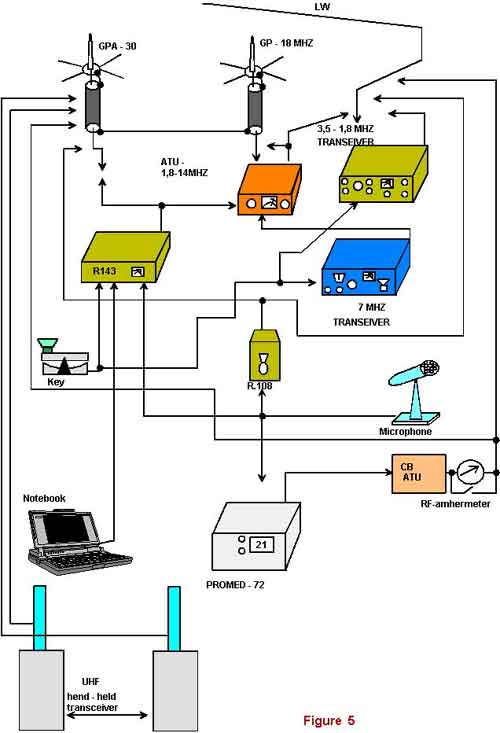
I want to distract, how Peter pushes buttons on the computer, and to present to you exposition of our work place, which we have organized for QRP-operation from Ai-Petri. The scheme of our work place is exhibited in fig. 5. In this figure the commutation of equipment and antennas is exhibited also.
We used three antennas on our QRP-station. Now I shall list them. It is GPA-30, made by Fritzel corporation, quarter-wave vertical on 18 MHz, and LW by 55 meters length. From transmitter we used R-143, CW-SSB, radio set, operating in 1,5-19,99 MHz range, and providing 8 watts power. Also we used two self-made CW transceivers (RK3ZK made). One for operation on 160 and 80 meters, of 400 milliwatts power, second on 40 meters, 1,5 watts power. Also we had military radio set R-108 for operation FM on 28-36 MHz, CB -transceiver "Promed-72" (AM, FM, grid "A") with self-made CB-matching device, two old soviet commercial VHF hand - held radio such as "Transport", notebook for operation SSTV-RTTY and self-made matching device for 1,8-14 MHz range. I took with myself also two matching device which we do not used. One was for 14-30 MHz range, another for 50 MHz range. But unfortunately we did not have equipment, for which it would be necessary to use these devices.
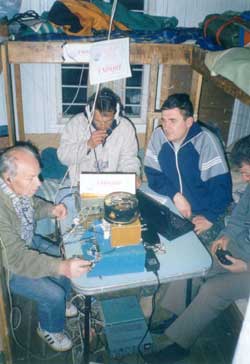
For SSTV-RTTV operation notebook was switch on to R-143. With the help of same radio set we realized SSB and CW operation. With the help of home made transceivers on ranges of 160-80-40 meters we constantly inspected circumstances in ether, and sometimes realized operation in ether on the equipment. Despite of small power of our equipment, sometimes there were interference at a simultaneous operation on transmission on two transceivers. Especially strong there interference were between transceivers by operation R-143 on 14 MHz range and home - made transceiver on 7 MHz range. By operation on R-143 on 10 MHz range, mutual interference on ranges 3,5 and 7 MHz were minor.
By operation on 18 MHz on R-143 we used the quarter-wave vertical, sometimes worked on GPA-30, which, as has appeared, fine works and in this range. For operation R-143 on 14 MHz range we used in basic GPA-30, but sometimes used LW together with matching device. For operation R-143 on 10 MHz we used LW together with a matching device, and sometimes and without it, depending on coated by clouds of our antenna. Sometimes R -143 well worked using only in-house matching device.
For operation R-143 on 80 meter range we used LW. More best results were obtained at usage LW together with a matching device, but also without it often satisfactory operation also was possible.
Some night I attempted to conduct CW QSO on 160 meter, using R-143 and LW together with matching device, but my attempts have failed. The CIS stations practically were absent in ether. The radioamateur telegraph stations of Western Europe were presented in ether. However unfortunately, I could not make up QSO with them �
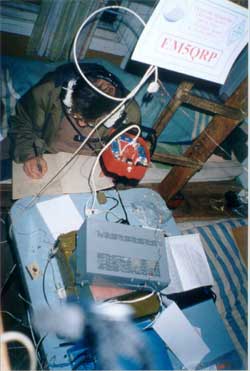
The CB-transceiver Promed-72 through CB - matching device and RF ampermeter was included either to an antenna LW or to the vertical on 18 MHz. The radio set R-108, in which the possibility of the matching of output stage with many types of antennas is stipulated, was shared with LW or GPA-30 antenna.
The self-made transceiver on 7 MHz worked together with matching device and LW antenna. Sometimes, at a good weather, this antenna fine worked with this transceiver and without matching device. But costed run to a cloud, as the parameters of our antennas varied, therefore the signal of the transceiver on transmission was considerably aggravated. The transceiver on 160-80 meters worked through matching device with LW antenna.
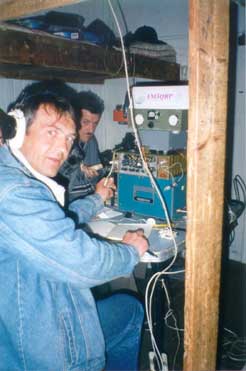
All equipment with hardly, but was located on one small desktop. From three sides of the desktop there were three work place. If to sit on a bed, where slept UA3WX, it was a work place for operation behind radio set R-143. On the part of a bed UU4JCQ there was a work place for operation on the CB-transceiver Promed-72, and for operation behind self-made CW-transceivers. On the part of an empty bed there was work place for operation RTTY. The plan of our work place is exhibited in fig. 6. The radio set R -108 was removed from desktop, when on this one did not work.
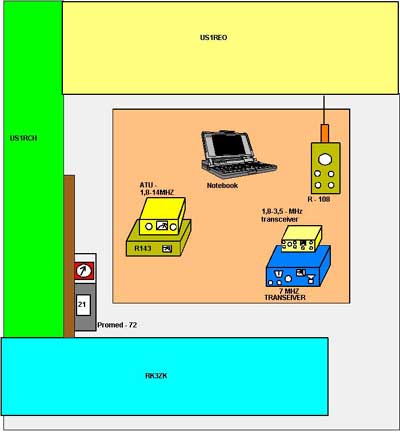
The transceiver Promed-72 was supported on a wooden girder of bed, therefore it was not hindered on desktop. Sometimes location of equipment during operation a little varied, but it is unessential. Such equipment installation has allowed to all members of our expedition to realize operation in ether and promoted to that we have conducted more than 500 QSO'S with 45 countries during our expedition.
But while I was engaged in exposition of our work place, Peter already has conducted first in the World RTTY QSO from Ai-Petri on 14 MHz with IV3HAX, IOTA EU-130. Having congratulated him about these event, I go on exposition of our work place further.
As our location, where 5 men lived, generally speaking was a little even for one man, the empty bed on the part of work place for RTTY was filled up with every possible radioamateur things. Lanterns, accumulators, electric soldering iron, different connectors - all lied in bulk on this bed. Despite of confusion, apparent at it, all this was convenient for usage.
But sometimes things in our small room were lost. And then five men could not find an electric soldering iron, or screwdriver, which only just lied on desktop. As joked Victor - US1RCH, the things "left in other parallel World". Fortunately, they there sojourned not for long, and soon were safely reset therefrom to us. Though � lantern of Peter US1REO at the end of our expedition has not returned therefrom.
I shall stop now on VHF operation. It is a lot of time they for us were permanently switched on reception our VHF radio set. But, is abortive! As the shelter was in low place, and furthermore the walls of our shelter were metal - i.e. in inside rooms there was a magnificent electrical shielding to hear someone on VHF with "rubber duck" antenna of the radio set it was impossible. Though the antenna GPA-30 also could ensure operation on 144 MHz (under the words Wladimir - UR7IRL), but its commutation on VHF station was not so convenient. Besides this antenna often was shared with other equipment, therefore, for operation on VHF we used it very seldom. All the same we have conducted VHF QSO with Yalta at the end of our expedition! It was realized due to perseverance of Nickolai UA3WX. Often he took with itself VHF radio and went out on plateau, and gave a common call - "CQ". Eventually good luck has smiled to him! QSO were conducted from an observation desk on mountain Ai-Petri, from which the line-of-sight on Yalta is carried out. On a straight line up to Yalta there were approximately 12-15 kilometers.
So, May 4 by 12 o'clock in the afternoon the work station of our expedition was completely generated. In such aspect, with small variations it will be saved to the termination of our expedition.